Hemp History
2700 B.C. Yan Emperor / Shennong
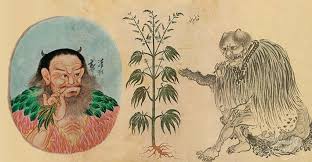
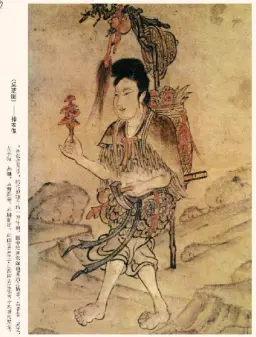
Shennong (Chinese: 神農; pinyin: Shénnóng), variously translated as "Divine Farmer"[1] or "Divine Husbandman", born Jiang Shinian (姜石年), was a mythological Chinese ruler known as the first Yan Emperor who has become a deity in Chinese folk religion. He is venerated as a culture hero in China.[2]
Shennong has at times been counted amongst the Three Sovereigns (also known as "Three Kings" or "Three Patrons"), a group of ancient deities or deified kings of prehistoric China. Shennong has been thought to have taught the ancient Chinese not only their practices of agriculture,[1] but also the use of herbal medicine.[3] Shennong was credited with various inventions: these include the hoe,[1] plow[1] (both leisi (耒耜) style and the plowshare), axe, digging wells, agricultural irrigation, preserving stored seeds by using boiled horse urine (to ward off the borers), trade,[1] commerce,[1] money, the weekly farmers market, the Chinese calendar (especially the division into the 24 jieqi or solar terms). He is also attributed to have refined the therapeutic understanding of taking pulse measurements, acupuncture, and moxibustion, as well as having instituted the harvest thanksgiving ceremony (zhaji (蜡祭) sacrificial rite, later known as the laji (腊祭) rite).[4]
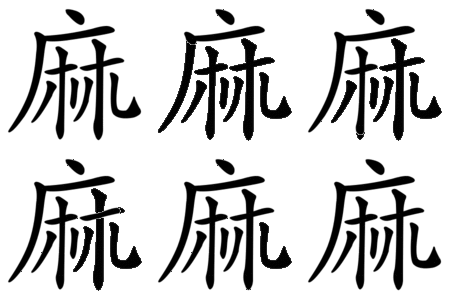
The Chinese character for hemp (麻 or má) depicts two plants under a shelter.[1] Notably, the same character also means "numb".[2] Cannabis cultivation dates back at least 3000 years in Taiwan.[3] | History of Cannabis article
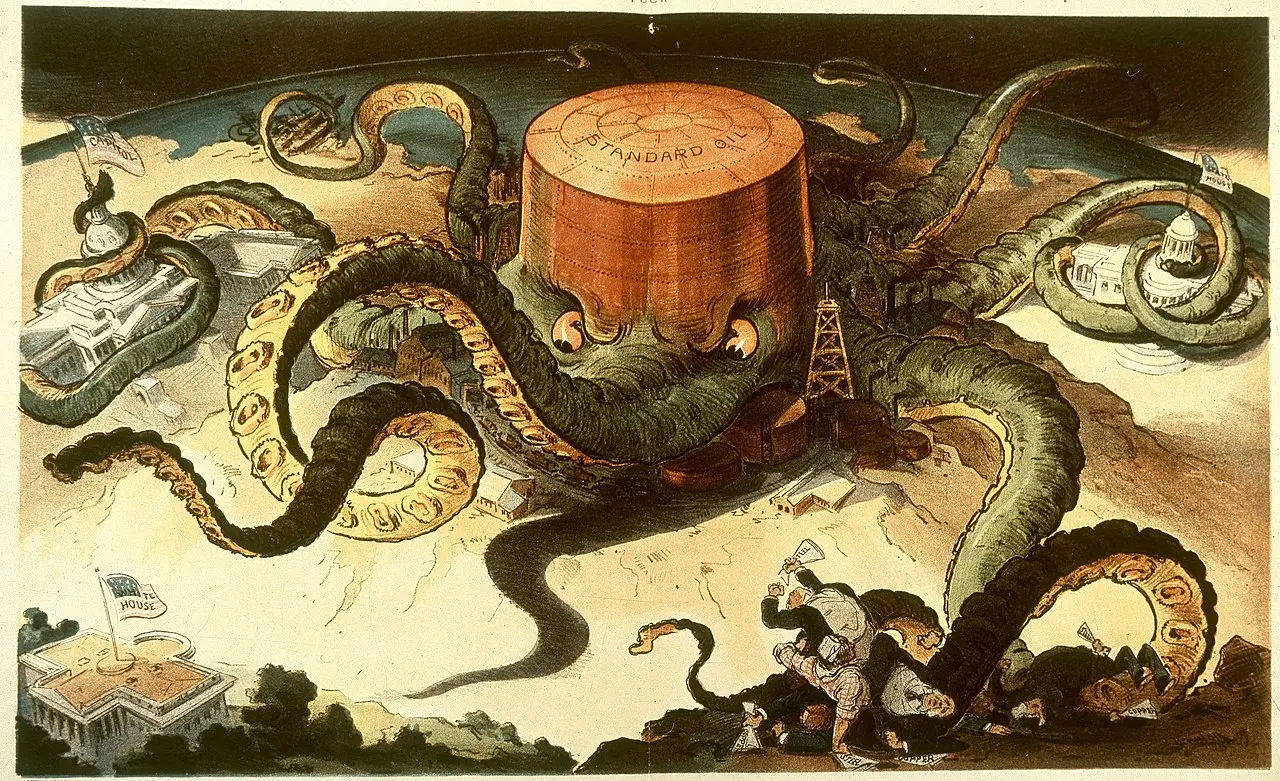
Political cartoon showing a Standard Oil tank as an octopus with many tentacles wrapped around the steel, copper, and shipping industries, as well as a state house, the U.S. Capitol, and one tentacle reaching for the White House. Published in Puck, v. 56, no. 1436 (1904 Sept. 7).
1937 United Stated Federal Prohibition: Marihuana Tax Stamp

The Marihuana Tax Act of 1937, Pub. L. 75–238, 50 Stat. 551, enacted August 2, 1937, was a United States Act that placed a tax on the sale of cannabis. It was the first national regulation on cannabis in the US.[1]
The H.R. 6385 act was drafted by Harry Anslinger and introduced by Rep. Robert L. Doughton of North Carolina, on April 14, 1937. The Seventy-fifth United States Congress held hearings on April 27, 28, 29th, 30th, and May 4, 1937. Upon the congressional hearings confirmation, the H.R. 6385 act was redrafted as H.R. 6906 and introduced with House Report 792. The Act is referred to, using the modern spelling, as the 1937 Marijuana Tax Act. It was overturned in 1969 in Leary v. United States, and was repealed by Congress the next year.[2]
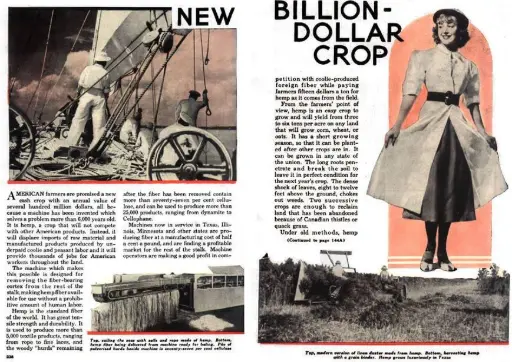
1938 Popular Mechnanics
Great stories have a personality. Consider telling a great story that provides personality. Writing a story with personality for potential clients will assist with making a relationship connection. This shows up in small quirks like word choices or phrases. Write from your point of view, not from someone else's experience.
HEMP TRILLION DOLLAR CROP Learn More >
1942 HEMP FOR VICTORY
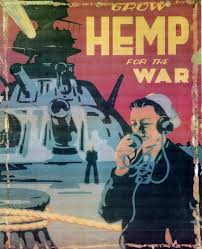
Hemp for Victory is a black-and-white United States government film made during World War II and released in 1942, explaining the uses of hemp, encouraging farmers to grow as much as possible. During World War II, the Marihuana Tax Act of 1937 was lifted briefly to allow for hemp fiber production to create ropes for the U.S. Navy but after the war marijuana reverted to its de facto illegal status.[1]
The film was made to encourage farmers to grow hemp for the war effort because other industrial fibers, often imported from overseas, were in short supply. The film shows a history of hemp and hemp products, how hemp is grown, and how hemp is processed into rope, cloth, cordage and other products.
Before 1989, the film was relatively unknown. The United States government denied ever having made such a film.[2] The United States Department of Agriculture[3] library and the Library of Congress told all interested parties that no such movie was made by the USDA or any branch of the U.S. government. Two VHS copies were recovered and donated to the Library of Congress on 19 May 1989 by Maria Farrow, Carl Packard, and Jack Herer.
1941 Hemp Soybean Car - Ford Motors
The soybean car was a concept car built with agricultural plastic. The New York Times in 1941 states the car body and fenders were made from a strong material derived from soy beans, wheat and corn.[2][A][4] One article claims that they were made from a chemical formula that, among many other ingredients, included soy beans, wheat, hemp, flax and ramie; while the man who was instrumental in creating the car, Lowell E. Overly, claims it was "…soybean fiber in a phenolic resin with formaldehyde used in the impregnation" (Davis, 51).[5] The body was lighter and therefore more fuel efficient than a normal metal body.[6] It was made in Dearborn, Michigan and was introduced to public view on August 13, 1941.[7] It was made, in part, as a hedge against the rationing of steel during World War II.[8][9] It was designed to run on hemp fuel.[10]
1972 DEA Domestic Cannabis Eradication/Suppression Program
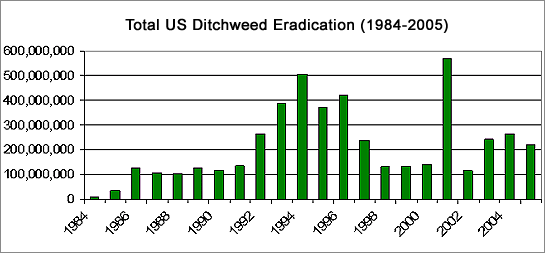
The Domestic Cannabis Eradication/Suppression Program is a Drug Enforcement Administration-funded program to eradicate cannabis in the United States. DEA began the program in 1979 during the war on drugs. In the first few years of the Reagan administration, the program expanded from seven states to forty.[1] By 1985 it was active in all fifty states.[2]
Results of the program vary by locality. In 2015, agents pulled 2.6 million cannabis plants in California, 27 in New Hampshire, and zero in Utah.[3]
As of 2018, the program continues alongside various degrees of legalization or decriminalization in all but three U.S. states.
https://en.wikipedia.org/wiki/Domestic_Cannabis_Eradication/Suppression_Program
1985 The Emperor Wears No Clothes
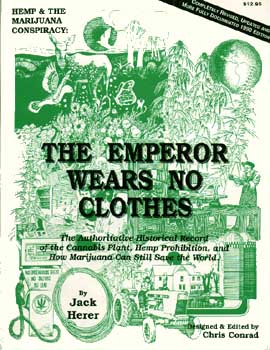
"If all fossil fuels and their derivatives, as well as trees for paper and construction were banned in order to save the planet, reverse the Greenhouse Effect and stop deforestation; then there is only one known annually renewable natural resource that is capable of providing the overall majority of the world's paper and textiles; meet all of the world's transportation, industrial and home energy needs, while simultaneously reducing pollution, rebuilding the soil, and cleaning the atmosphere all at the same time... and that substance is -- the same one that did it all before -- Cannabis Hemp... Marijuana!" Jack Herer | The Emperor Wears No Clothes article
Great stories have a personality. Consider telling a great story that provides personality. Writing a story with personality for potential clients will assist with making a relationship connection. This shows up in small quirks like word choices or phrases. Write from your point of view, not from someone else's experience.
Great stories are for everyone even when only written for just one person. If you try to write with a wide, general audience in mind, your story will sound fake and lack emotion. No one will be interested. Write for one person. If it’s genuine for the one, it’s genuine for the rest.
LEGALITY OF CANNABIS MAP
(we need to create one or a page like this)
The legality of cannabis for medical and recreational use varies by country, in terms of its possession, distribution, and cultivation, and (in regards to medical) how it can be consumed and what medical conditions it can be used for. These policies in most countries are regulated by three United Nations treaties: the 1961 Single Convention on Narcotic Drugs, the 1971 Convention on Psychotropic Substances, and the 1988 Convention Against Illicit Traffic in Narcotic Drugs and Psychotropic Substances.[1][2] Cannabis was reclassified in 2020 to a Schedule I-only drug under the Single Convention treaty (from being a Schedule I and IV drug previously), with the schedules from strictest to least being IV, I, II, and III.[3][4] As a Schedule I drug under the treaty, countries can allow the medical use of cannabis but it is considered to be an addictive drug with a serious risk of abuse.[4][5] | Legality of Cannabis article.

Map showing legal status of medical cannabis across the world. Legal as authorized by a physician Legal for any use (no prescription required) Data taken from Wikipedia:Legality of cannabis. Map does not reflect countries that have approved use of isolated cannabinoid drugs, such as Sativex or Marinol.
1936 Reefer Madness
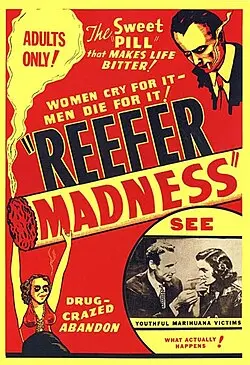
Reefer Madness is an American public service announcement and exploitation film about drug use and abuse. It was originally titled Tell Your Children, and it has been known by the titles The Burning Question, Dope Addict, Doped Youth, and Love Madness as well.
In the film, aspiring high school students are enticed by pushers to try marijuana. They become addicted and engage in criminal activities such as a hit and run accident, manslaughter, murder, conspiracy to murder and attempted rape. They suffer hallucinations, descend into manic-depressive episodes and insanity, and associate with organized crime. One character commits suicide.
Design features
Our design features offer a range of tools to create visually stunning websites. Utilize WYSIWYG editors, drag-and-drop building blocks, and Bootstrap-based templates for effortless customization. With professional themes and an intuitive system, you can design with ease and precision, ensuring a polished, responsive result.
Building blocks system
Create pages from scratch by dragging and dropping customizable building blocks. This system simplifies web design, making it accessible to all skill levels. Combine headers, images, and text sections to build cohesive layouts quickly and efficiently.
Bootstrap-Based Templates
Design Odoo templates easily with clean HTML and Bootstrap CSS. These templates offer a responsive, mobile-first design, making them simple to customize and perfect for any web project, from corporate sites to personal blogs.